

Make certain to store delicate credentials and keys in tamper-resistant, isolated hardware systems, safeguarded with software https://www.ourbow.com/use-video-conferencing-to-keep-in-touch-with-friends-and-family/ and bodily security measures. There are several critical factors within the definition above that we ought to always consider. First, an immutable process or id is one thing that can’t change. When deciding on a microcontroller for our product, we should be positive that we can permanently “burn-in” vital information used by the Root-of-Trust such as an organization personal key.
Stage 2: Secure Boot Chain
One operating in the same handle area as the application may be read. The Tock kernel is compiled specifically for a selected hardware system, termed a board. Any time you need to compile the kernel or edit the board file, you’ll go to that folder.
Tee-aided Write Safety Against Privileged Information Tampering
The complexity of the function listing will determine the sort of management logic that works best for a RoT. Right Here of note is that a root of belief is defined to be done in hardware, and that its main function is to be the first part of a chain of belief. Whereas other requirements will leave the implementation of a RoT as open-ended, this white paper will observe UEFI’s conference, so that right here “RoT” is identical as a hardware root of trust, or HRoT. With “firmware” within the group’s title, it is easy to see that having a secure boot course of (perhaps using a sequence of trust anchored with a RoT – see Determine 2, below) is the primary objective of the UEFI when defining a RoT. Note that the authorization for upstream blocks comes from downstream blocks; for instance, within the figure below, the BIOS would have to be approved by the RoT before execution control can be passed from the RoT to the BIOS. Hardware root of trust might help with a range of safety points that are primarily divided into pre-boot and post-boot.
Man-in-the-middle (mitm) Assaults
Finally, to prevent the foundation key from being ascertained through physical examination of the inner memory array, the selection of anti-fuse primarily based OTP recollections could give more peace of mind over these based mostly on eFuses. A Root of Belief (RoT) is a tamper-resistant hardware element to establish a secure foundation for a system. The RoT is designed to carry out crucial security features, such as generating and storing cryptographic keys, attestation of system identity, together with verifying the integrity of firmware and software program, and securely booting the system.
As lengthy as users are satisfied that they don’t want the pliability that a CPU can offer, a onerous and fast SM management may be a less expensive answer. The Foundation of Belief (RoT) is a secure and trusted place to begin built into hardware or firmware that types the inspiration for all security operations in a tool. When a tool powers on, the RoT verifies that the firmware and software are authentic and haven’t been tampered with, ensuring that solely trusted code runs. In Addition To selecting the right sort of storage, function record, and management logic for the RoT, it is equally necessary to make sure the RoT has a compatible interface with the general design. Having a RoT that can be dropped into one’s design with little to no modifications can be the easiest answer. It can be good to search for a RoT with native assist for the AXI/AHB/APB bus protocol.
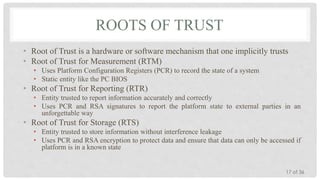
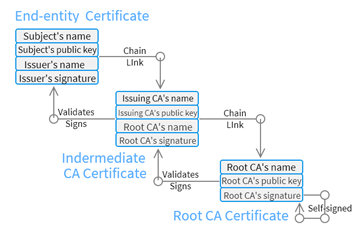
Roots of trust provide a firm foundation from which to construct security and trust. Root of trust establishes the secure process boot up chain, referred to as Chain of Trust, used to validate software program and hardware used on the gadget. If the credentials used to implement the initial piece of code are verified, every successive piece of code executed is trusted. A robust root of belief consists of id and cryptographic keys rooted in the hardware of a device. This establishes a unique, immutable, and unclonable id to authorize a device in a network.
Assaults could be non-invasive, corresponding to side-channel analysis (where the goal is to steal safe information from the RoT, such as the boot code, non-public keys or distinctive ID). Attacks is also more direct, corresponding to physical tampering attacks, one instance being fault injection on I/O or power pins in an effort to make the RoT misbehave. Attackers can physically tamper with IoT devices which makes software-based security inadequate to guard IoT from fraud, tampering and different integrity and DDoS attacks.
What Are The Kinds Of Root Of Trust?
The server compares these values in opposition to known-good reference values. If they match, the server trusts the gadget; if not, it can refuse entry or trigger a remediation workflow. Software-based “Roots of Trust” violate no much less than one of these properties.
- Having a correct function record, suitable storage factor, and compatible bus interface will assist to ensure that the chosen RoT will function correctly under regular situations.
- Of course, the system might be booting successfully, however what occurs if some piece of malware is the first thing that runs, and the the rest of the software is trusting that code?
- The complexity of the operate list will determine the sort of control logic that works best for a RoT.
- The first item is “trust” – that’s, the system can depend on the RoT at all times, particularly at boot up.
- This permits us to construct secure systems without proprietary limitations, paving the way for a standardized, trustworthy firmware operating on everyday methods.
With the diversity of endpoints the place a RoT could be installed, the importance of making an informed choice for the best match RoT cannot be overstressed. The best plan of action could be to methodically think about the assorted components, beginning with a transparent definition of the tasks that the RoT will be known as upon to carry out. Once the wants have been outlined, it is a matter of going “shopping” and selecting these safety providers (and corresponding crypto modules) that may assist the required tasks.
This normally includes anti-tamper protection, isolated environments, resilience to side-channel assaults, and layered security measures to avert points of failure. Root of Trust attacks are silent killers; they’re subtle, making them a dangerous menace. They’re designed to strike at the foundation of our digital security stack, undermining the protection layers. Supply chain assaults exploit the vulnerabilities of a company, which may embrace internal or exterior vulnerabilities similar to software program, hardware, or enterprise operations. If a microcontroller does not have a Root-Of-Trust built-in, it is attainable to establish one utilizing third-party elements, trusted firmware for Cortex-M (TF-M), and so forth.